
If you have built a successful Canadian-controlled private corporation (CCPC) or Medical Professional Corporation (MPC), you have likely accumulated substantial retained earnings inside your corporate structure.
While earning money inside a corporation enjoys a low active business tax rate, getting that wealth out into your family’s hands is one of the most expensive hurdles in Canadian tax law. Paying out retained earnings as taxable dividends can trigger personal tax rates approaching 48%, and leaving those assets inside the corporationuntil death can expose your estate to double or triple taxation.
How the IFA-Enhanced CDA Creates “Surplus Tax-Free Capacity”
The Capital Dividend Account (CDA) is a notional tax account that tracks tax-free surpluses inside a private corporation. Any positive balance in the CDA can be paid out to Canadian-resident shareholders as a 100% tax-free capital dividend.
When a corporation owns a life insurance policy, the death benefit received by the company credits the CDA by an amount equal to:
$$\text{CDA Credit} = \text{Total Death Benefit} - \text{Adjusted Cost Basis (ACB)}$$
When you combine corporate-owned life insurance with an Immediate Financing Arrangement (IFA), a remarkable structural multiplier occurs:
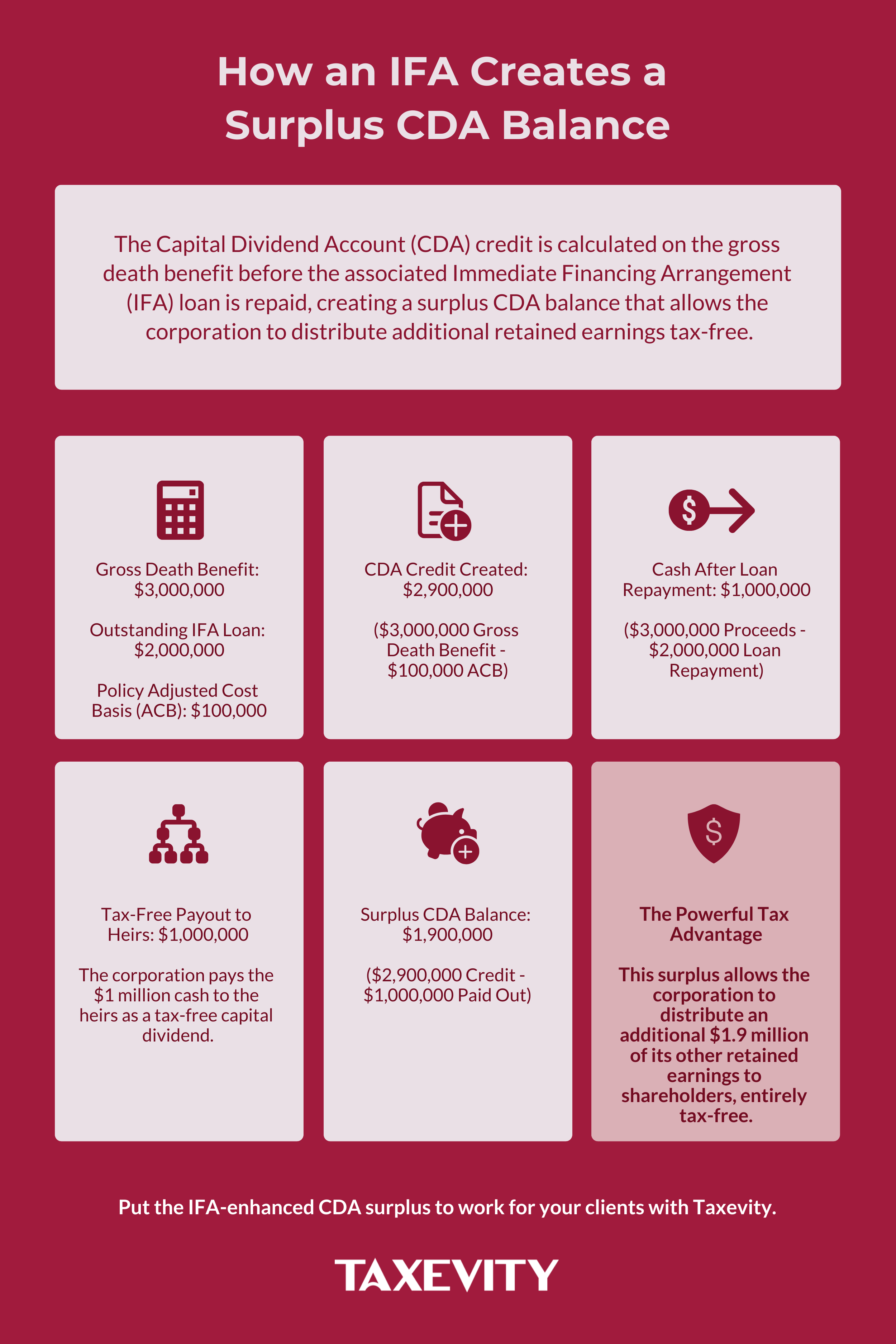
- The Insurance Payout & Loan Repayment: Suppose your corporation holds a policy with a $3,000,000 death benefit, an ACB of $100,000, and an outstanding IFA collateral loan of $2,000,000. At death, the $3,000,000 payout retires the $2,000,000 loan, leaving $1,000,000 of net insurance cash inside the corporation.
- The Gross CDA Credit: Under the Income Tax Act, the CDA credit is calculated on the gross death benefit ($3,000,000 minus $100,000 ACB = $2,900,000 CDA Credit), unaffected by the collateral loan repayment.
- Unlocking $1.9M of Trapped Corporate Wealth: After paying out the $1,000,000 of remaining insurance cash tax-free, your corporation still has $1,900,000 of Surplus CDA Capacity. Your estate can use that $1,900,000 credit to distribute $1,900,000 of your corporation’s existing investment portfolio to your heirs completely tax-free.