
Does your “paper” risk tolerance match how you actually feel when the market drops? And how does that emotional reality impact your tax and wealth architecture?
As a successful high-net-worth investor, you are no stranger to risk. You take calculated risks to build your wealth every day. Yet, when it comes to managing your portfolio, there is often a massive gulf between your theoretical risk tolerance and your actual behaviour.
When you sit down with your wealth advisor to complete a risk profile, you are likely in a calm, rational state of mind, answering questions about hypothetical market losses in a vacuum. But when the markets actually drop, emotional preservation kicks in. Behavioural finance consistently shows that an investor’s real-world tolerance for capital drops is almost always lower than what they confidently circled on paper.
This paradox creates a fascinating dynamic when we introduce advanced tax and wealth strategies, specifically an Immediate Financing Arrangement (IFA).
Often, a conservative investor—or their protective wealth advisor—will instinctively reject an IFA because it involves leverage. But what if your risk tolerance for an IFA is actually higher than you realize?
The Flaw in Conventional Leverage
To understand why IFAs are often misunderstood, we have to look at conventional investment leveraging (like margin loans).
Traditional leverage is built on fluctuating assets. If you borrow against your stock portfolio and the market corrects, the value of your collateral shrinks. This triggers a margin call, forcing you to either inject more capital or sell assets at a major loss. The risks are magnified, and your wealth advisor is completely justified in wanting to protect you from this 2:1 or 3:1 leverage trap.
The IFA Difference: Building on Bedrock
An Immediate Financing Arrangement is fundamentally different. It is not a speculative investment play; it is a structural financial strategy.
In an IFA, you (or your holding company) purchase a participating whole life insurance policy. You then secure a line of credit using the policy’s Cash Surrender Value (CSV) as collateral, reinvesting those funds back into your wealth advisor’s portfolio.
Why is this different from a margin loan? Because the guaranteed portion of whole life CSV is mathematically designed to only grow. It is completely insulated from stock market volatility. If the TSX or S&P 500 drops 20%, your foundational collateral does not decline. There are no margin calls triggered by a market correction.
The Ultimate Proof of Risk: Ask the Banks
If you are wondering whether this sounds too good to be true, you don’t need to take our word for it. You just need to look at the lending guidelines of Canada’s major financial institutions—the ultimate, objective arbiters of risk.
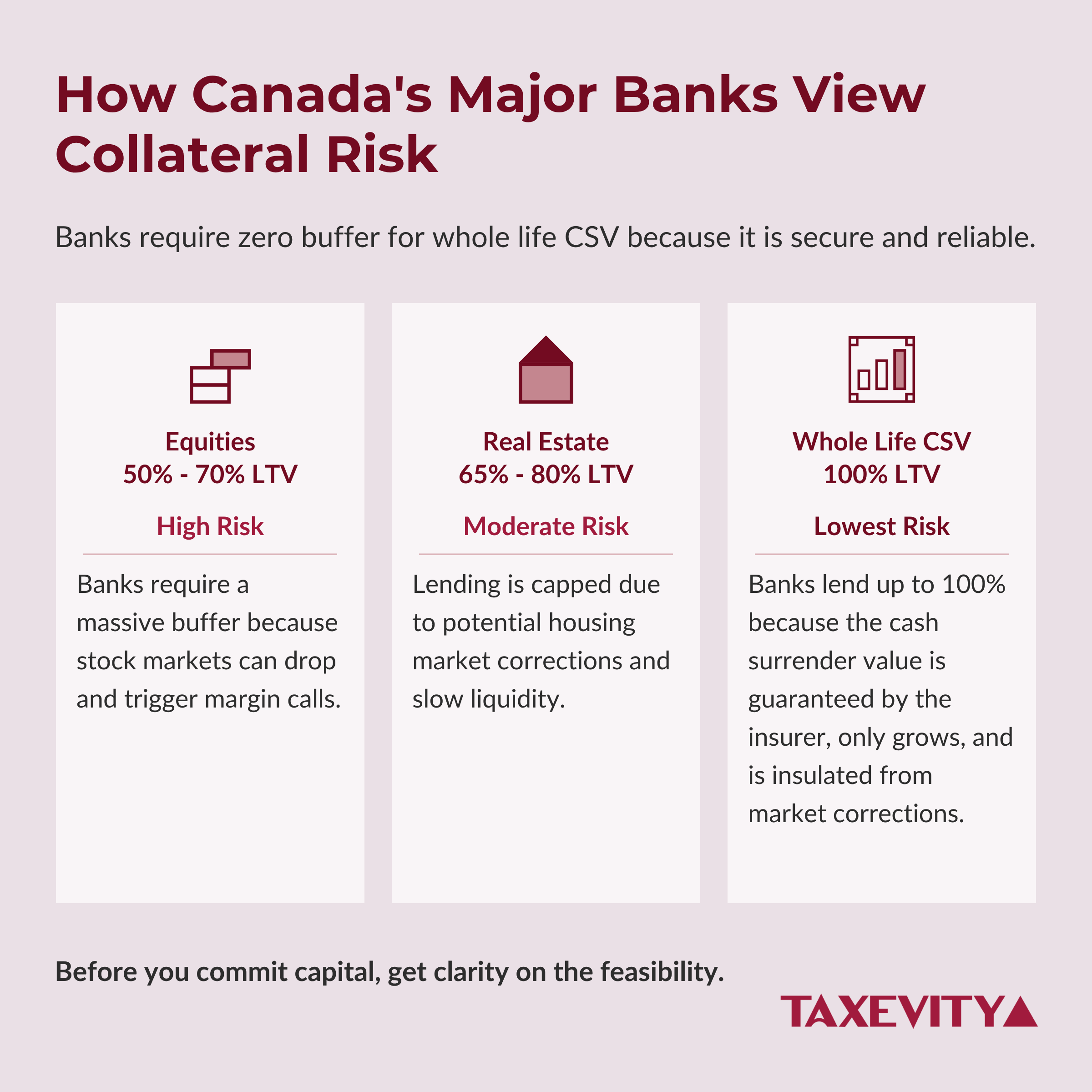
- Equities: Banks typically lend 50% to 70% Loan-to-Value (LTV) on a diversified stock portfolio. They know the market can drop, so they require a massive buffer.
- Real Estate: Banks typically cap out at 65% to 80% LTV on home equity. Housing markets can correct, and liquidity is slow.
- Whole Life CSV: Major Canadian Schedule 1 banks will lend up to 100% LTV on the guaranteed CSV of a participating whole life policy.
Bank risk analysts have mathematically determined that this collateral is so secure, and so insulated from market volatility, that they require zero buffer. If Canada’s biggest banks view CSV as the safest collateral available, it is entirely logical that a conservative investor would share that exact same risk tolerance.
Why Focus on Cash Surrender Value? (And Not Your Home)
While you could leverage home equity to access capital, leveraging whole life insurance through an IFA is a sophisticated architectural play. For HNW investors, the primary issue isn’t just accessing cash; it’s the heavy tax burden of growing and transferring wealth.
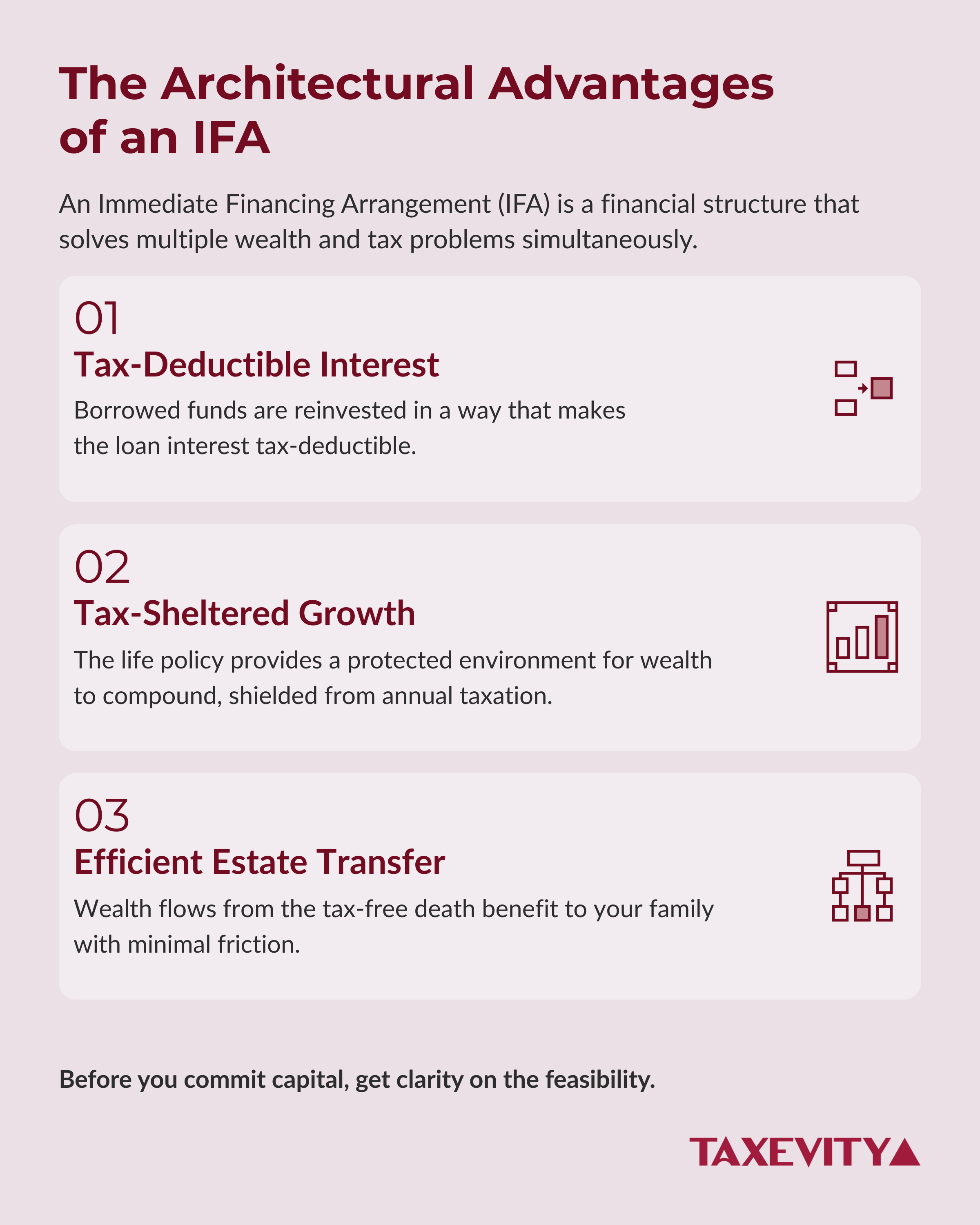
Structuring an IFA solves multiple problems simultaneously:
- Tax-Deductible Interest: The borrowed funds are reinvested to produce income, making the interest tax-deductible.
- Asset Protection: It provides a tax-sheltered environment for your wealth to grow.
- Estate Transfer: Whether through Capital Dividend Account (CDA) credits for corporate investments, or tax-free death benefits personally, wealth flows to your family highly efficiently at death.
The Swamp: Where an IFA Actually Breaks
We are Architects, which means we must also show you the blueprints for how this structure can fail. An IFA is highly insulated from stock market crashes, but it is not immune to risk. The risk is just different.
The strategy can face severe pressure if borrowing rates (Prime) spike significantly higher than the dividend yield of the insurance policy, creating a negative spread. Additionally, locking capital into a policy reduces your short-term liquid cash buffer. If you cannot survive a 3-year liquidity crunch or stomach an 8% Prime stress test, the strategy breaks.
The Collaborative Team Approach
Occasionally, a wealth advisor might hesitate to recommend an IFA because they understandably believe they can generate stronger long-term returns for you by keeping that capital directly invested in the market without the insurance layer. But an IFA bridges this gap collaboratively. The premium is paid to the insurer, but the bank loans 100% of that capital right back. That capital is then directed back to your wealth advisor to manage. They continue to invest the assets, but now those assets are working alongside a highly efficient tax strategy.
Ultimately, an IFA is not merely an investment decision; it is a tax and estate planning decision. The ultimate arbiters of whether this strategy is right for you must be you and your accountant.
At Taxevity, we act as the architects. Our role is to sit at the table with your accountant and your wealth advisor to stress-test the math and ensure the strategy provides the vital protection you need, the growth you want, and the impact you desire.